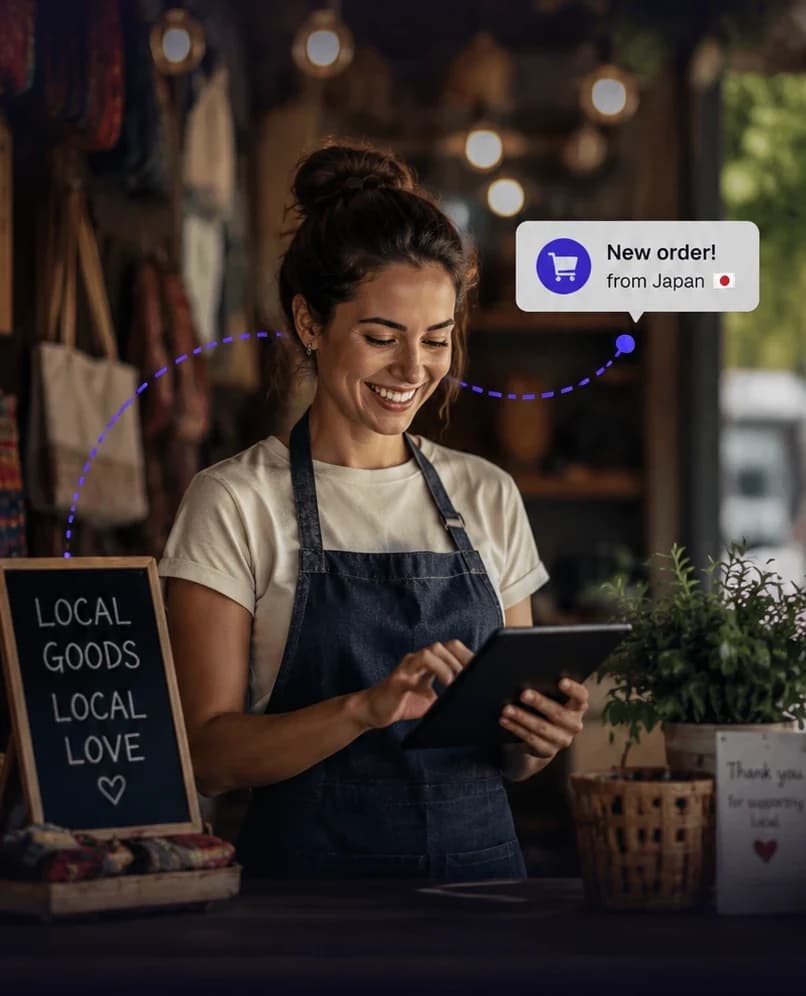
It is a Saturday morning at a summer craft market and your stall is doing steady business. A couple approaches, clearly tourists, studying your hand-thrown ceramic bowls with the focused attention of people who are genuinely interested, not just browsing. The woman picks up a large serving bowl, turns it over, checks the base, and sets it down to ask a question. She is speaking Japanese. Her partner says something in response, also in Japanese, and they both look at you expectantly. You smile and say your prices, pointing at a small handwritten card. She nods but asks something else, about shipping, you think, or maybe about whether the glaze is food-safe. You are not sure. The sale is real but so is the communication wall. You open Mingle on the small tablet propped behind your display. Within thirty seconds you know she is asking about food safety, you explain which lead-free glaze you use, how it is fired and that you can share the glaze maker's safety details, she understands, and she buys two bowls and asks if you ship to Osaka.
How stallholders handle this today
- Conduct the entire interaction through a price calculator held up between you and the customer, tapping numbers back and forth while the nuance of the question (food safety, materials, shipping) goes entirely unanswered.
- Call a bilingual friend or family member and hold the phone out awkwardly between you and a stranger for a conversation that takes three times as long as it should.
- Smile, shrug, and lose the sale because the customer's real question, the one that would have closed the deal, never got answered.
Answering the question that closes the sale
- Open Mingle on a small tablet or phone propped at the stall, speak your answer in English, and the customer reads it in Japanese on the screen or hears it read aloud: the question about glaze safety, shipping costs, or custom orders gets a real answer.
- For a longer chat, tap Share session and let the customer scan the QR code: they follow in Japanese on their own phone and ask follow-ups freely, which you read in English. On a single device, swap the languages from the session menu for their questions instead. Either way, a potential lost sale becomes a complete transaction.
- Word of mouth from well-served international customers is more valuable than any market stall signage, and Mingle helps you earn it.
Setting up Mingle at your stall
- 01
Prop a small tablet or spare phone at the stall
A tablet stand behind your display gives you a hands-free translation station that customers can see and approach. It signals that you are prepared to serve them in their language.
- 02
Use auto-detect to understand an unknown language
Craft markets attract tourists from many countries. Auto-detect translates whatever a customer says into English, so you can understand them without guessing their language. It works for listening only: to answer, pick their language yourself (ask, or point at the list), because Mingle does not show which language it detected.
- 03
Use the session for product explanations, not just prices
Prepare two or three sentences about your materials, process, and policies in advance. Being able to explain in any language that your ceramics are hand-thrown, which glaze you use and how its food safety was checked is a significant competitive advantage over other stalls.
What sellers ask before trying it
"Is it awkward to use a translation app with a customer standing at your stall?"
Less awkward than the alternative. Customers who genuinely want to buy something are grateful for any tool that lets the conversation happen. Most respond warmly to the effort. The awkward moment is the shrug and the lost sale, not the tablet on the counter.
"What if multiple customers arrive at the same time and they speak different languages?"
Serve one conversation at a time, as you would in any busy stall. Mingle's auto-detect handles the language switch automatically when you start a new session with a different customer. The switch takes seconds.
FAQ
Can I use Mingle to explain my craft process in detail to interested customers?
Yes. Some of the most effective uses of Mingle at craft markets are extended conversations where the maker explains their process, materials, and inspiration to a curious customer. A customer who understands how something was made is more likely to buy it.
Does Mingle work outdoors with market noise?
It can, but noise is the most common cause of missed words. Hold the phone close to whoever is speaking, shield it from wind, and step back from a loudspeaker or generator if you can. Read prices and quantities back to confirm them. Try it at your own stall on a busy day before relying on it.
Can I take shipping orders during the conversation and be confident the address details are accurate?
For shipping addresses, we recommend having the customer type their address directly into your order form rather than relying on spoken translation of an address, which avoids the risk of phonetic confusion in street names and postal codes.
Is there a cost-effective plan for seasonal vendors who only need Mingle at weekend markets?
Yes. Paid plans are billed monthly with no annual commitment, starting at $4 a month, so you can subscribe for the season and cancel afterwards. Yearly billing, at 10% off, only makes sense if you trade all year.
Do both people need the app installed?
No. It runs in the browser. Tap Share session and show the QR code: the other person joins on their own phone in their language, with no app and no account, and you both speak freely. On one shared phone, a session translates one direction, and you swap the languages when they reply.
Is Mingle free to try?
Yes — start a guest session instantly, no card required. Paid plans unlock longer sessions, saved history, and team features.
Try it at your next conversation.