How it works
Why Live Translation Lags Behind the Speaker, and How to Close the Gap
Live translation often trails the speaker by a few seconds. Where the delay comes from, which part you can fix, and why reading beats waiting to listen.
- live translation
- troubleshooting
- speech-to-speech
- latency
You finish your sentence, look up, and wait. Two, three seconds later the other person hears it in their language and answers, and by then you are both talking at once. Lag is the most common complaint about live translation. Some of it is built into how translation works; some of it you can cut today.
How much lag is normal?
A few seconds behind the speaker is normal for spoken translation today, even from the largest companies:
- Google Meet. Google's help page for speech translation says translations are a few seconds delayed for completeness.
- Apple Live Translation. In a Which? test, the testers noticed delays with the in-ear translation, especially with long or complex sentences, and ended up reading the translation in the app because it was faster.
- AirPods in German. Macworld's reviewer found the AirPods generally waited until well into the sentence, often to the end, before starting the translation.
So the question is not how to get to zero. It is how to keep the gap small enough that the conversation still flows.
Where the seconds go
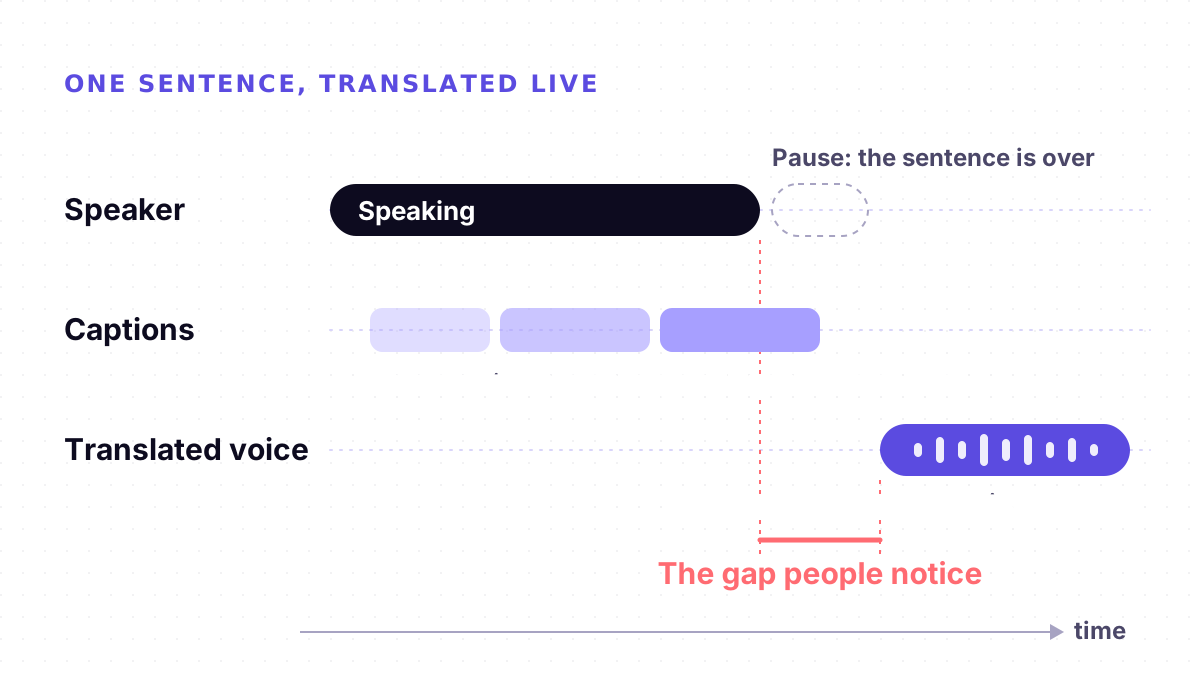
Waiting for enough of the sentence. Words alone are ambiguous. "I can't make it to the meeting..." could end with "tomorrow" or "unless we move it". A translator that starts speaking too early has to guess, so most wait for a pause or for enough words to be sure.
The verb at the end. Japanese, Hindi and Urdu put the verb at the end of the sentence, and German often does: "Ich habe den Vertrag gestern unterschrieben" only says "signed" in its last word. English wants the verb early, so a translator into English has to wait for it. Researchers describe live translation as notoriously difficult because of these word-order differences, and have built systems that stay a fixed number of words behind the speaker or try to predict the final verb before it is said.
Knowing the sentence is over. Translators usually treat a short pause as the end of a sentence. Someone who speaks in long, unbroken runs gives the tool no place to stop, so the translation arrives in late, large pieces.
Turning text into a voice. Captions can appear early and correct themselves as more words arrive. Spoken audio cannot be taken back once it has played, so a spoken translation usually waits for a more complete sentence than captions do.
Bluetooth. Wireless earbuds add their own delay. SoundGuys measured roughly a third of a second for common Bluetooth codecs on Android phones in 2021; wired earbuds add none.
The connection. Cloud translation needs a network. A weak signal slows everything above.
Seven ways to make translation feel real time
Read first, listen second. Captions keep up better than the voice. Let the listener read along and treat the spoken translation as confirmation.
Keep sentences short. One idea per sentence, then a short pause. That pause is the signal the translator waits for.
Say the point first. "Yes, we can move the meeting to Friday" gets translated sooner and more safely than a long run-up with the answer at the end.
Use wired earbuds or the speaker. If someone is listening through Bluetooth earbuds and the delay feels long, try wired earbuds or the phone speaker.
Keep the screen on. Mobile browsers pause the microphone when the screen locks, which looks like the translation froze. See why live translation stops when the screen locks.
Get a steady connection. Move to Wi-Fi or a stronger signal if the delay keeps growing during a session.
One speaker at a time. Overlapping voices make the translator wait for a clear turn, and both people end up repeating themselves.
When a few seconds matter, and when they don't
For travel, a front desk, a call with family or a meeting with clear turns, a few seconds of delay is easy to live with once both people expect it. Quick banter, jokes and arguments suffer most, because the timing is part of the meaning. For legal and medical decisions, use a professional interpreter: accuracy matters there more than speed.
Mingle runs in a browser on any phone or computer. It shows captions while the person is still talking and speaks the translation moments later; each session translates one direction, and you swap the languages from the session menu when the other person replies. See how a translated conversation in the browser works.
For transparency: Mingle is our product. We have not published latency measurements or run side-by-side speed tests, so we do not quote a figure for Mingle or claim it is faster than the tools above. The habits in this guide help with all of them.
Sources
Checked on 23 October 2026.
- Google Meet Help: Learn about speech translation
- Which?: We tested Apple's Live Translation feature: does it really work? (28 July 2026)
- Macworld: AirPods Live Translation tested in English and German (19 December 2025)
- Ma et al. (2019), STACL: Simultaneous Translation with Implicit Anticipation and Controllable Latency, ACL 2019
- Grissom et al. (2014), Don't Until the Final Verb Wait: Reinforcement Learning for Simultaneous Machine Translation, EMNLP 2014
- Wikipedia: Subject-object-verb word order
- SoundGuys: Android's Bluetooth latency needs a serious overhaul (2021)
Drafted with AI assistance, edited and fact-checked by Tabish Irfan. How we write and check articles
FAQ
How much delay is normal in live translation?
A few seconds behind the speaker is normal for spoken translation today. Google says Meet's speech translation is a few seconds delayed for completeness, and testers of Apple's Live Translation reported noticeable delays in their earbuds, especially with long or complex sentences. Captions usually keep up better than the spoken voice.
Why does the translator wait until I finish my sentence?
Because the end of a sentence can change its meaning, and in some languages the main verb only arrives at the end. Translating too early risks guessing wrong, so most tools wait for a pause or enough words to be sure. Short sentences with a clear pause at the end get translated sooner.
Do Bluetooth earbuds make translation slower?
They can add a little. Bluetooth audio has its own delay, measured by SoundGuys at roughly a third of a second for common codecs on Android phones in 2021, while wired earbuds add none. It is small next to the translation itself, but it adds up in a back-and-forth conversation.
Is reading the captions faster than listening to the translation?
Usually, yes. Captions can appear and update while the person is still talking, while a spoken translation has to wait for a fuller sentence before it can be said. In Which?'s test of Apple's Live Translation, the testers ended up reading the translation in the app because it was faster than the earbuds.
Why does live translation stop or fall far behind on my phone?
Often the phone has paused the microphone: mobile browsers stop listening when the screen locks, which looks like the translation froze. Keep the screen on during a session. A weak connection can also slow cloud translation, so move to a stronger signal or Wi-Fi if the delay keeps growing.
How fast is Mingle?
Mingle shows captions while the person is still talking and speaks the translation moments later. We have not published latency measurements, so we do not quote a figure or claim it is faster than other tools. Each session translates one direction; swap the languages from the session menu when the other person replies.
Keep reading
Related posts
How it works Why Live Translators Get Names Wrong, and How to Get Them Through
In one test, live translation turned British Airways into 'Briti shareway'. Why names break more than other words, and eight habits that get them through.
4 min read
Guides AirPods Live Translation Not Working? Five Checks, One Known Crash, and a Fallback
AirPods Live Translation won't start, crashes or lacks your language? Five checks for iPhone, AirPods, Apple Intelligence and languages, plus a fallback.
5 min read
Languages Hindi, Urdu and Hinglish: Why Voice Translators Trip on Mixed Speech
Millions of people mix English into Hindi and Urdu. Why live voice translators stumble on it, Hindi or Urdu output, and six habits that help.
5 min read
Try live translation free
No app install. Any phone. 60+ languages.
Start free session