How it works
Why Live Translators Get Names Wrong, and How to Get Them Through
In one test, live translation turned British Airways into 'Briti shareway'. Why names break more than other words, and eight habits that get them through.
- troubleshooting
- speech-to-speech
- live translation
- names
Which? asked bilingual speakers to test Apple's Live Translation in 2026. The translations were mostly accurate, but the feature got muddled with names: it turned "British Airways" into "Briti shareway". Which? noted that is not great if you are asking for directions. Every live translator has this weak spot, and it is not the translation that usually fails. It is the hearing.
Where names break
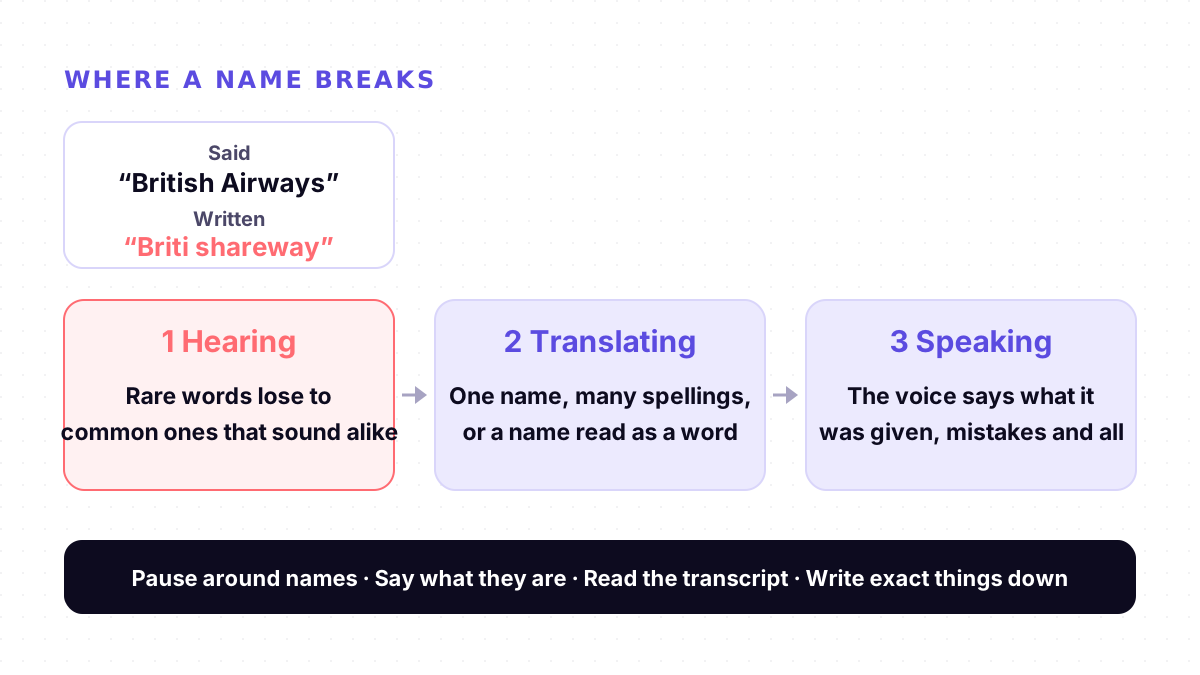
1. Hearing: the recognizer picks common words. Live translation first turns speech into text. A recognizer chooses the most likely words for the sounds it hears, and names lose that contest. Google's own documentation for its speech recognition says words such as proper names are rare in general use, and gives restaurant names as an example of words less likely to be chosen. Noise and an unfamiliar accent make it worse. "British Airways" said quickly sounds like other words, and the recognizer writes those.
2. Translating: the name is treated as a word. If the text is right, the translator can still go wrong. A person's name that is also an ordinary word can be translated as the word. Names from one script are also written many ways in another: Muhammad is also written Mohammed, Mohamed, Mohammad and more, one of the highest numbers of English spelling variants of any name, so a correct name can come out in a spelling the person never uses.
3. Speaking: the voice says what it was given. The translated voice reads the text it receives. It cannot fix a name that was misheard two steps earlier. For how the steps fit together, see speech-to-speech translation explained.
Eight habits that get names through
1. Pause before and after the name. A short pause gives the recognizer a clean boundary instead of a name blurred into the words around it.
2. Say what it is. "The airline British Airways", "Doctor Faisal", "the town of Murree". The extra word tells the recognizer what kind of word comes next, and tells the listener a name is coming.
3. Do not rush the name. People say their own names fast because they say them every day. Say it at the speed you would use for a stranger.
4. Read the transcript, not only the translation. If the captions of what you said have the name wrong, the translation has it wrong too. Repeat it before the conversation moves on.
5. Give the tool context if it lets you. Some tools accept a topic or a list of words in advance. Google's Speech-to-Text lets developers add words and phrases so they are recognized more often. In Mingle, see below.
6. Use the right mode for specialist words. Medicine and product names are names too. A tool with a specialist mode for the subject has the words it is likely to hear.
7. Put exact things in writing. Addresses, flight numbers, medicines, account names and spellings: write them down or show them on a screen. A live translator is for the conversation around them.
8. Use a professional for high stakes. For medical and legal decisions, a professional interpreter checks names and terms in a way no live tool does today.
What Mingle does with names
Mingle has an optional Session topic field when you set up a session. Up to 200 characters of it are passed to the speech recognizer as context for the whole session. The field's help text suggests words like "doctor visit" or "business meeting"; you can also add the names you expect, for example "Meeting with Dr. Faisal Qureshi about the Lahore office". We have not measured how much this improves names, so try it with your own before you rely on it.
The session also has conversation modes: General conversation, Technical / IT, and Pharmacy / medication. The last two add word lists for their subject, which covers many product and medicine names. The captions show what was heard as people speak, so a misheard name is visible before anyone acts on it.
For transparency: Mingle is our product. We have not published accuracy figures, for names or anything else, and Mingle mishears names too. The habits above work with any live translator.
Sources
Checked on 27 October 2026.
Drafted with AI assistance, edited and fact-checked by Tabish Irfan. How we write and check articles
FAQ
Why does live translation change people's names?
Because the speech recognizer chooses the most likely words for the sounds it hears, and names are rare in everyday speech. Google's speech documentation says words such as proper names are rare in general use and therefore less likely to be chosen. If the recognizer writes the wrong words, the translation and the spoken voice repeat the mistake.
Can I teach a translator my name?
Some tools let you give them words in advance. Google's Speech-to-Text lets developers add words and phrases so they are recognized more often. Consumer apps rarely offer this. In Mingle, the optional session topic is passed to the speech recognizer as context for the whole session, so you can include the names you expect.
Should names be translated?
People's names should normally stay as they are. Some places have established names in other languages, such as Germany and Deutschland, and a good translation uses those. The risk is a person's name that is also a word, which a translator may turn into the word.
Why are Arabic and Urdu names spelled differently in English?
Because there is no single way to write Arabic-script names in Latin letters. Muhammad, for example, is also written Mohammed, Mohamed, Mohammad and many other ways; Wikipedia notes it has one of the highest numbers of English spelling variants in the world. A translator may pick a spelling the person does not use, so confirm spellings in writing.
Is live translation safe for medicine names?
Treat it as a help, not a guarantee. Medicine names are rare words that sound alike, so read the transcript, check the name on the packaging or prescription, and write it down. For medical decisions, use a professional interpreter. Mingle is not HIPAA compliant.
Does Mingle get names right?
Sometimes not, like every live translator. We have not published accuracy measurements, so we make no claim about names. The habits in this guide help with any tool, and in Mingle you can add expected names to the session topic and check the captions as people speak.
Keep reading
Related posts
How it works Why Live Translation Lags Behind the Speaker, and How to Close the Gap
Live translation often trails the speaker by a few seconds. Where the delay comes from, which part you can fix, and why reading beats waiting to listen.
5 min read
Guides AirPods Live Translation Not Working? Five Checks, One Known Crash, and a Fallback
AirPods Live Translation won't start, crashes or lacks your language? Five checks for iPhone, AirPods, Apple Intelligence and languages, plus a fallback.
5 min read
Languages Hindi, Urdu and Hinglish: Why Voice Translators Trip on Mixed Speech
Millions of people mix English into Hindi and Urdu. Why live voice translators stumble on it, Hindi or Urdu output, and six habits that help.
5 min read
Try live translation free
No app install. Any phone. 60+ languages.
Start free session