Languages
Hindi, Urdu and Hinglish: Why Voice Translators Trip on Mixed Speech
Millions of people mix English into Hindi and Urdu. Why live voice translators stumble on it, Hindi or Urdu output, and six habits that help.
- live translation
- language pairs
- hindi
- urdu
- code-switching
"Kal ki meeting reschedule kar do." Plenty of people in Delhi or Lahore say a sentence like that without noticing it is in two languages. Ask a voice translator to handle it and you may see "meeting" turn into a Hindi word that only sounds like it. Here is why that happens, what changes between Hindi and Urdu, and the habits that get mixed speech through a live translator in one piece.
Mixing English into Hindi and Urdu is normal speech
Linguists call it code-switching: moving between languages inside one conversation, often inside one sentence. In Hindi it is known as Hinglish. The authors of a 2025 Hinglish speech dataset estimate that more than 250 million people use code-switched communication, and describe it as especially common in urban and semi-urban areas.
Urdu speakers do the same in speech, and many also write Urdu in the Latin alphabet when texting: Roman Urdu. It is mostly used for informal messages and social media, and it has no standard spelling.
Neither habit is a mistake. Office words (meeting, deadline, file), technology (phone, password, update) and numbers are routinely said in English inside a Hindi or Urdu sentence. A translator that only works when people avoid that is not working for how people actually talk.
Why voice translators trip on mixed speech
A voice translator first turns speech into text, then translates the text, then speaks or shows the result. Most mistakes start in that first step. (For the whole pipeline, see speech-to-speech translation explained.)
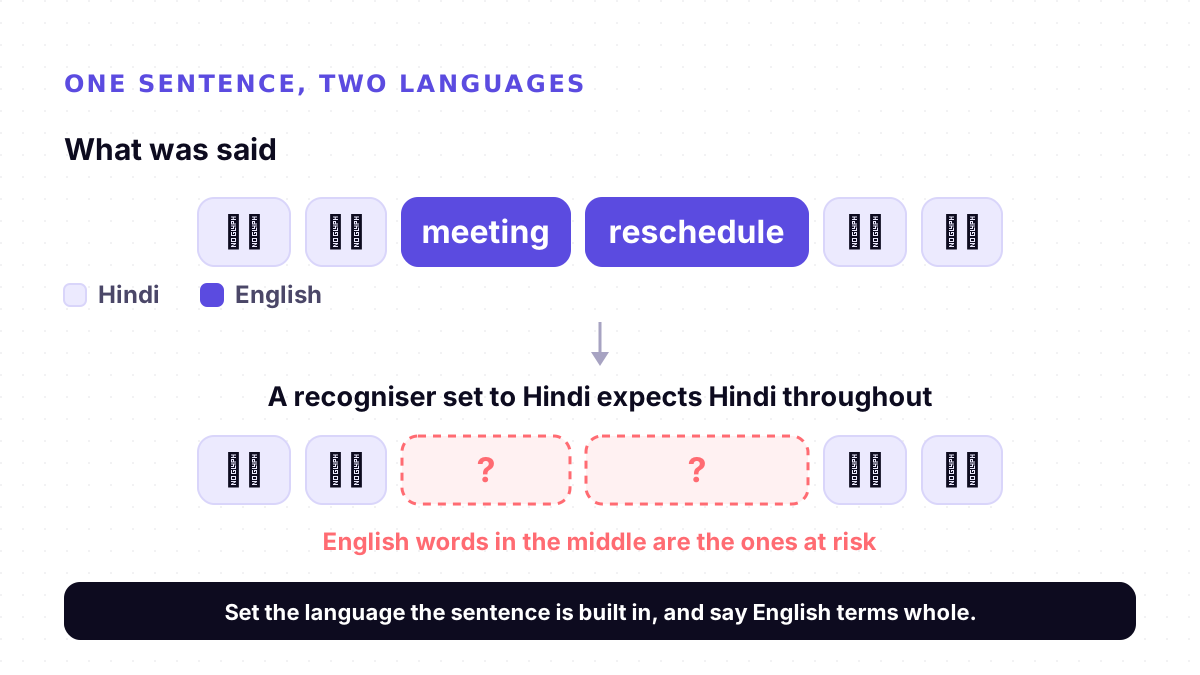
One language per sentence. Many speech recognisers settle on a language for a stretch of speech and keep it. When the setting is Hindi, an English word in the middle has to fit Hindi sound and word patterns, so a similar-sounding Hindi word can win, or the word is dropped.
Less training speech. Recognisers learn from recorded speech, and much more of it is in one language at a time than in mixed form. The researchers behind the 2025 HiACC dataset report that recognition error rates rise by roughly 30 to 50 percent, in relative terms, on code-switched speech.
The error travels. Translation faithfully translates whatever recognition heard. If "reschedule" was misheard, the other person gets a confident sentence about something else.
Hindi or Urdu: the same speech, two scripts
Spoken Hindi and Urdu are mutually intelligible: everyday speech is shared, and the formal vocabulary differs. Hindi is written in Devanagari; Urdu in Urdu script, in the Nastaliq style, from right to left.
For a translator, that has two practical effects:
- Choose the output by the reader. A shopkeeper in Lahore reads Urdu script; a colleague in Pune reads Devanagari. Both can usually follow the spoken translation either way, but the captions only help the person who can read them.
- Roman script is not an output. Live translators generally write Hindi in Devanagari and Urdu in Urdu script. Someone who only reads Roman Urdu should listen to the spoken translation rather than read.
Six habits that make mixed speech translate better
Set the language your sentence is built in. If the grammar is Hindi or Urdu and only some nouns are English, choose Hindi or Urdu as the language you speak. If you mostly speak English with the odd Urdu word, choose English.
Say English terms whole. "Reschedule" said in one breath has a better chance than "re... schedule". Do not pause in the middle of a term.
Pause between thoughts. A short pause tells the translator that a sentence has ended. Long, running sentences that switch language several times are the hardest case.
One speaker at a time. Two voices at once, in two languages, is difficult for any recogniser.
Check names, numbers and medicines. These are the words recognisers miss most and the ones that matter most. Read them in the captions, and repeat or spell them if they are wrong.
Read as well as listen. Captions show what was recognised. If the caption is wrong, the spoken translation will be too, and you can correct it before the other person acts on it.
Hindi and Urdu in common tools
Google's live translate help page lists both Hindi and Urdu, with the two people taking turns and the translation played aloud. Google Meet's translated captions also list Hindi and Urdu (see Google Meet translation for plans and limits).
Mingle translates Hindi and Urdu among 60+ languages in a phone or computer browser, with no app for either person. Hindi captions appear in Devanagari and Urdu captions in Urdu script, right to left. Borrowed English words in the middle of a sentence do not stop the session. Each session translates one way: swap the languages from the session menu when the other person replies. The English to Hindi and English to Urdu guides cover each pair.
For transparency: Mingle is our product. We have not run side-by-side accuracy tests on mixed speech, so we make no claim that Mingle handles Hinglish better than Google Translate or any other tool. The habits above help with all of them.
Sources
Checked on 23 October 2026.
- Singh, Singh and Kadyan (2025), HiACC: Hinglish adult and children code-switched corpus, Data in Brief 62
- Agro et al. (2025), Code-Switching in End-to-End Automatic Speech Recognition: A Systematic Literature Review
- Wikipedia: Hindustani language
- Wikipedia: Roman Urdu
- Google Translate Help: Hear live speech to speech translations with live translate
- Google Meet Help: Use translated captions in Google Meet
Drafted with AI assistance, edited and fact-checked by Tabish Irfan. How we write and check articles
FAQ
Can voice translators understand Hinglish?
Often, but less reliably than one language. Researchers who built a Hinglish speech dataset report that recognition error rates rise by roughly 30 to 50 percent, in relative terms, on code-switched speech. Common English words inside a Hindi or Urdu sentence usually come through; rare terms, names and quick switches are where mistakes cluster, so check them in the captions.
Should I choose Hindi or Urdu in a translator?
Choose by the reader. Spoken Hindi and Urdu are mutually intelligible, so either side can usually follow the spoken translation. The written captions differ: Hindi appears in Devanagari, Urdu in Urdu script, read right to left. Pick Urdu for someone who reads Urdu script and Hindi for someone who reads Devanagari.
Can a live translator write Roman Urdu or Roman Hindi?
Live voice translators generally write each language in its own script: Hindi in Devanagari and Urdu in Urdu script. Roman Urdu has no standard spelling, which is part of why tools stick to the standard scripts. If a reader only reads Roman script, have them listen to the spoken translation instead of reading the captions.
Why does the translator change my English words into Hindi words?
When recognition is set to Hindi, an English word in the middle of the sentence has to compete with Hindi words that sound similar, and a similar-sounding Hindi word can win. Saying the English term whole and clearly, without a pause in the middle of it, gives it the best chance. Check the captions for the words that matter most.
Does Google Translate conversation mode support Urdu?
Yes. Google's help page for live translate lists both Hindi and Urdu, with the translation played aloud and the two people taking turns. Availability of live translate features has been rolled out country by country, so check the app in your region.
Does Mingle handle Hindi and Urdu mixed with English?
Mingle translates Hindi and Urdu among 60+ languages, and borrowed English words in the middle of a sentence do not stop the session. We have not run side-by-side accuracy tests, so we do not claim it handles mixed speech better than other tools. Each session translates one way; swap the languages from the session menu when the other person replies.
Keep reading
Related posts
How it works Why Live Translators Get Names Wrong, and How to Get Them Through
In one test, live translation turned British Airways into 'Briti shareway'. Why names break more than other words, and eight habits that get them through.
4 min read
Guides AirPods Live Translation Not Working? Five Checks, One Known Crash, and a Fallback
AirPods Live Translation won't start, crashes or lacks your language? Five checks for iPhone, AirPods, Apple Intelligence and languages, plus a fallback.
5 min read
How it works Why Live Translation Lags Behind the Speaker, and How to Close the Gap
Live translation often trails the speaker by a few seconds. Where the delay comes from, which part you can fix, and why reading beats waiting to listen.
5 min read
Try live translation free
No app install. Any phone. 60+ languages.
Start free session