速い。プライベート。正確。
Egyptian Arabic Translator: Live Voice Translation for Masri
Egyptian Arabic (Masri) is the dialect most of the Arab world can follow, and the one translation tools rarely offer as its own option.
- プライベートで安全
- どこでも使える
- アプリ不要
あなた(English)
こんにちは
相手(العربية)
العربية
ゲストとして無料でお試しいただけます。カード登録もインストールも不要です。ログインすると、無料プランでセッションを最大10回ご利用いただけます。
This opens an English ↔ Arabic session, the same one as our Arabic guide. There is no separate Egyptian setting: Egyptian speech is understood as Arabic, and Mingle's Arabic replies are general Arabic, not Masri.
リアルタイム翻訳
話したそばから瞬時に字幕表示。
自然な音声出力
読み上げ機能でArabicを自然な音声で聞けます。
プライベートで安全
会話は暗号化され、プライベートに保たれます。
どこでも使える
ブラウザだけで動作 — アプリのインストールは不要。
早わかり
Mingle translates spoken Egyptian Arabic into English live in the browser, and English into Arabic, one direction per session: you swap the languages to switch. It is set to keep Egyptian words as they were spoken instead of converting them to formal Arabic, which helps with the Masri-to-English direction. There is no Egyptian setting for Mingle's Arabic output, so your English comes out as general Arabic rather than written Masri. Egyptians read and understand it, though it can sound more formal than everyday speech.
右から左への字幕表示
Arabicの字幕を正しい右から左の順序で明瞭に表示します。
会話のスピードに対応
自然な実際の会話スピードにもついていけます。
読み上げ対応
必要なときはArabicを自然な音声で聞けます。
3ステップで始める
- 1
2つの言語を選ぶ
言語はすでにEnglish→Arabicに設定済み — いつでも入れ替えできます。
- 2
マイクをタップしてアクセスを許可
ブラウザの許可は1回だけ。開始にアカウントは不要です。
- 3
話すだけ
話した内容がそのままライブ字幕になり、読み上げをオンにすればイヤホンから自然な音声で流れます。スマホの画面は相手に向けたまま。双方向で話したいときは、セッションを相手のスマホと共有できます。
Egyptian Arabic is the everyday language of Egypt and, through a century of Egyptian film, television and music, a dialect many other Arabic speakers can follow. Yet translation tools almost never offer it as its own language. This page explains what that means for a live conversation, and exactly how far Mingle goes.
Why "Egyptian Arabic translator" is a real search
If you have typed a sentence into a translator for a conversation in Cairo and watched the other person pause, you have met the problem. The tool gave you formal Arabic. People around you were speaking Masri.
The reason is data. Machine translation learns from large amounts of written text, and Modern Standard Arabic (MSA) has centuries of it: newspapers, books, official records. Egyptian Arabic is mostly spoken, so there is much less to learn from, and tools lean towards what they know.
Egyptian Arabic vs Modern Standard Arabic
MSA is the Arabic of news broadcasts, government documents and school textbooks. It is shared across the Arab world and it is nobody's mother tongue. Egyptians grow up speaking Masri and reading MSA, switching between them by context. Linguists call this diglossia.
The two differ most in the words used in almost every sentence:
| Meaning | Egyptian (Masri) | Modern Standard Arabic |
|---|---|---|
| what? | إيه (eh) | ماذا (madha) |
| where? | فين (fein) | أين (ayna) |
| how? | إزاي (ezzay) | كيف (kayfa) |
| I want | عايز ('ayez) | أريد (urid) |
| now | دلوقتي (dilwa'ti) | الآن (al-aan) |
| not | مش (mish) | ليس (laysa) |
A reply in MSA is not wrong so much as formal. It is the difference between "might you indicate the nearest pharmacy" and "where's the pharmacy". Both are understood, but in a fast conversation the formal version can make the other side slow down or switch to English to be polite.
Which tools offer Egyptian Arabic in 2026
We checked the published language lists on 21 September 2026:
- Google Cloud Translation: Arabic, plus Arabic (Saudi Arabia) for its newer translation model. No Egyptian option.
- DeepL: one Arabic. No dialect options.
- Microsoft Translator: one Arabic. No dialect options.
- Soniox, the speech engine Mingle runs on: one Arabic. No dialect options.
None of these offers Egyptian Arabic as a separate choice. They can all process Egyptian speech or text to some degree, but none lets you request Masri output. General AI chatbots will attempt Masri when asked. We have not tested how well they do, so we make no claim about them.
How Mingle handles Egyptian Arabic
Mingle is live voice translation in the browser. For Egyptian Arabic it uses the ordinary English ↔ Arabic session, the same as our English to Arabic guide. Here is what that means in each direction.
Egyptian Arabic to English. Mingle is set to keep spoken dialect as spoken, instead of converting it to formal Arabic, and its speech hints include common Egyptian words such as مش, عايز, ازيك and كده. Your side sees English captions, and hears them with Read Aloud on. This is the direction where the dialect handling helps you.
English to Arabic. There is no Egyptian setting for Mingle's output. Your English is translated into general Arabic, shown in Arabic script and, with Read Aloud on, spoken in a standard Arabic voice. An Egyptian listener will understand it. Expect it to sound closer to the formal column of the table above than to Cairo street speech.
It runs in the browser on a phone, tablet or laptop. With one phone on the table between you, the other person needs nothing at all. No app, and no account to start: try it free as a guest.
Where this helps
Travel and daily life in Egypt. Markets, taxis, cafes and directions run on Masri. Understanding the replies is usually the hard part, and that is the direction Mingle handles best.
Family across languages. Relatives who speak Masri at home can talk with English-speaking family, reading or hearing each other's words in real time.
Hotels and front desks. For Egyptian guests at a front desk, see our hotel front desk guide for a setup that works on one shared tablet.
An honest note on dialect translation
No automated tool captures a living dialect perfectly. Slang moves quickly, speech varies even within Egypt, and how formal a phrase sounds depends on who is speaking to whom. We have not published accuracy measurements for Egyptian Arabic, so we do not claim a figure. For an ordinary conversation, try it with a short exchange first. For anything legal, medical or contractual, where precision is binding, use a human interpreter.
参考情報
- Google Cloud Translation, supported languages (docs.cloud.google.com/translate/docs/languages), checked 21 September 2026.
- DeepL API, supported languages (developers.deepl.com), checked 21 September 2026.
- Microsoft Azure Translator, language support (learn.microsoft.com), checked 21 September 2026.
- Soniox, supported languages: Arabic is listed as one language (soniox.com/docs), checked 21 September 2026.
- Word comparisons: editorial, awaiting review by a native Egyptian speaker.
イヤホンで体験する瞬間 — 相手はスマホに話し、あなたは自分の言語で聞く
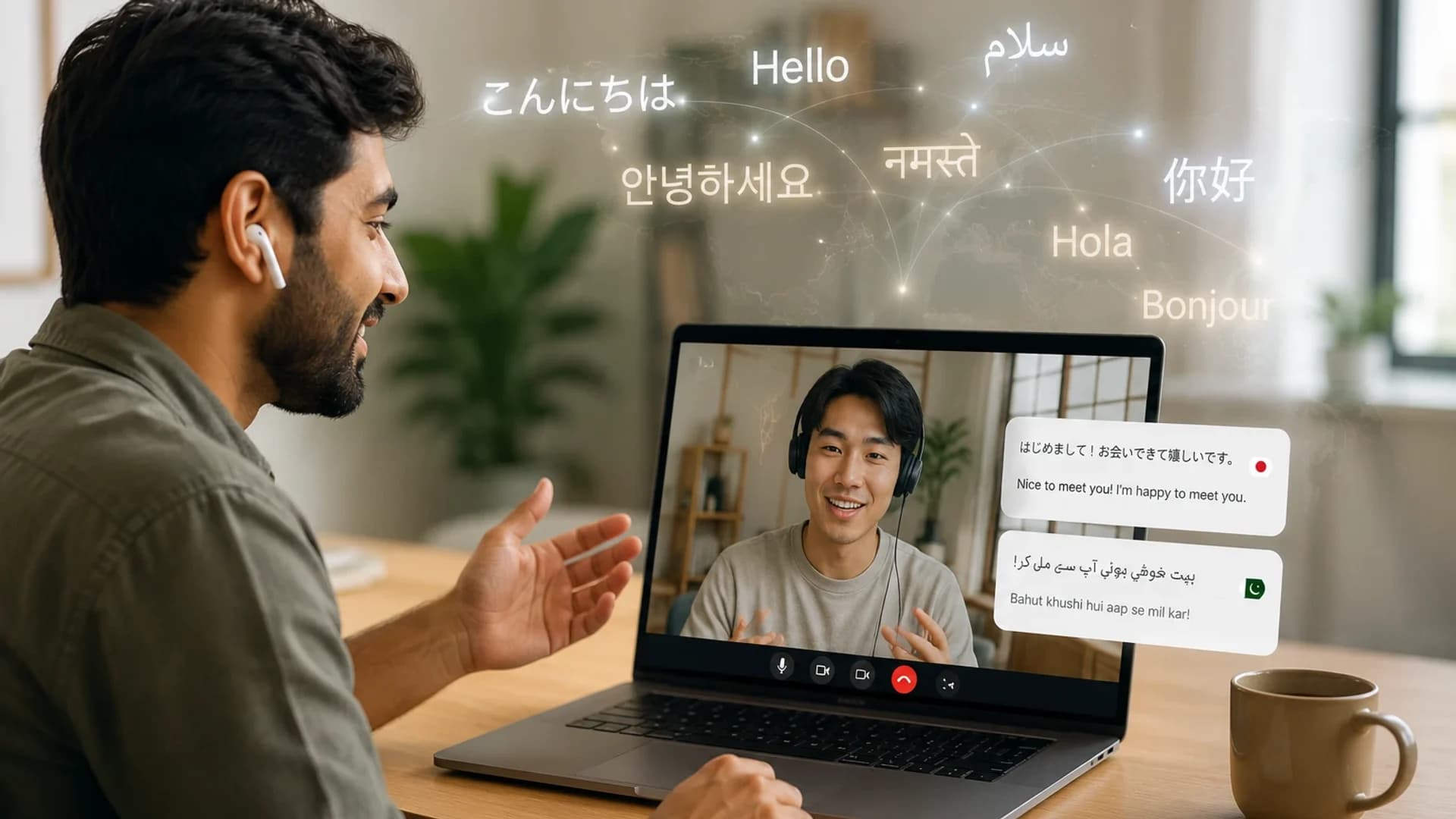
スマホをテーブルに置いて相手に向け、読み上げをオンにします。相手の声はスマホのマイクに入り、翻訳された音声はイヤホンから静かに再生されます。プライベートでハンズフリー、機器に向かって大声を出す必要はありません。
読み上げはスマホの通常の音声出力から再生されるため、スマホが使う有線・Bluetoothイヤホンならほとんどの場合そのまま使えます。スマホがイヤホン側のマイクに切り替わってしまう場合は、デバイス設定で内蔵マイクを選び、あなたではなく相手の声を拾うようにしてください。
相手にもあなたの声を届けたいですか?「セッションを共有」をタップしてQRコードを見せましょう。相手が自分のスマホで自分の言語に参加すれば、お互いに何も受け渡すことなく、相手の言葉を読んだり聞いたりできます。1台のスマホで使う場合は、セッションメニューから言語を入れ替えれば返答用に切り替えられます。
よくある質問
よくあるご質問
EnglishからArabicへの翻訳について知っておきたいことをまとめました。
今すぐEnglish↔Arabicのセッションを始めよう